
Labor Day weekend often brings increased impaired-driving enforcement across Georgia, including Atlanta and nearby communities. For 2026, the national Drive Sober or Get Pulled Over enforcement campaign runs from August 19 through September 7. Georgia also lists the One Hundred Days of Summer H.E.A.T. campaign through September 7 and Hands Across the Border from August 24 through August 28.
These campaigns can increase patrol activity and road checks, but they do not confirm that every Atlanta-area agency will operate a checkpoint. During any traffic stop, you should provide required identification and vehicle documents, keep your hands visible, follow lawful safety instructions, and avoid roadside arguments. You may politely decline investigatory questions, a consent search, voluntary field sobriety exercises, and a preliminary roadside breath test.
Respectful cooperation does not require you to volunteer evidence. You can remain calm, provide required documents, and clearly state that you do not consent to questions, searches, or voluntary roadside testing.

2025 Atlanta's Best - Defense Law Firm
BadAss Attorney

Best Lawyers In America

10 Consecutive Years Selected to Super Lawyers

AVVO Client's Choice

Best Lawyers Best Law Firms
Why DUI Stops Increase Around Labor Day 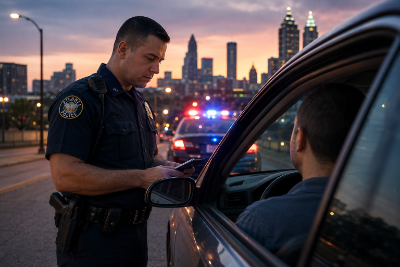
Labor Day is one of the final major travel weekends of summer. Federal, state, and local agencies may increase patrols and impaired-driving enforcement during this period. Georgia’s One Hundred Days of Summer H.E.A.T. campaign targets impaired driving, speeding, distracted driving, seat-belt violations, and other dangerous conduct.
A DUI investigation in Atlanta may begin after an officer reports speeding, an unsafe lane change, delayed movement at a traffic signal, a lighting violation, or another suspected traffic offense. It may also begin at a planned roadblock.
An officer’s decision to stop you does not prove impairment. An arrest also does not establish guilt. The reason for the stop, the officer’s observations, the testing process, and the available video can all become part of a later legal review.
Learn more about challenges to an Atlanta traffic stop:
https://www.willislawga.com/atlanta-unlawful-police-stop-attorneys/
The Difference Between a Traffic Stop and a DUI Roadblock
During a standard traffic stop, an officer generally needs a lawful basis to stop your vehicle. That basis may involve a suspected traffic violation or specific facts suggesting criminal activity. Whether the officer had sufficient grounds can become a central issue in a DUI defense.
A DUI roadblock works differently because officers may stop vehicles without individualized suspicion when the checkpoint satisfies constitutional requirements. Georgia courts examine factors such as:
- Whether supervisory personnel approved the checkpoint for a lawful primary purpose
- Whether officers stopped all vehicles rather than selecting vehicles randomly
- Whether the delay to drivers was minimal
- Whether the checkpoint was clearly identified as a police operation
- Whether screening officers had enough training and experience to make initial decisions
Do not make an illegal turn or unsafe maneuver to avoid a checkpoint. Once stopped, remain calm, follow traffic and safety directions, and preserve legal objections for your attorney and the court.
Learn more about Atlanta DUI roadblocks:
https://www.willislawga.com/atlanta-dui-roadblocks-attorneys/
He's the only lawyer in the State of Georgia to ever be recognized for all three of these accomplishments. Received the Samurai Lawyer Award for having gone to jail for a total of 4 days in order to save his own client Received the BadAss Lawyer Award for the biggest impact of all DUI lawyers in DUI defense in the country Received the vote of Georgia Lawyers as a Superlawyer in DUI Law for 10 straight consecutive yearsGreg Willis has been successful at defending DUI cases (over 93.1% without a conviction)
What You Should Do When the Lights Come On
Signal promptly and pull into a safe location. When an immediate stop would place you or the officer in danger, reduce your speed, activate your hazard lights, and move to the nearest safe area. Keep your hands visible. At night, you may turn on the interior light so the officer can see inside the vehicle.
When requested, provide your driver’s license and required vehicle documents. Tell the officer before reaching into a glove compartment, console, bag, or pocket. Avoid sudden movements, insults, arguments, or physical resistance.
A practical approach includes the following steps:
- Pull over safely and remain inside unless instructed otherwise
- Keep your hands where the officer can see them
- Provide your driver’s license and required vehicle documents
- Keep voluntary answers brief
- Do not guess, exaggerate, or provide a detailed account of your evening
- Do not interfere physically with an officer
- Ask, “May I leave?” when the officer appears to have completed the stop
Greg has truly mastered his craft. His preparation is second to none and his confidence helps reduce the nervousness and anxiety his clients face. He is a real life version of Harvey Specter and I highly recommend him.” - Travis Greg and his team are absolutely incredible. Greg explained everything to me in detail, as this is the first ever time I have been arrested. Regular updates throughout the process which allowed me to get on with everyday life. 200% I would recommend Greg and his team to anyone with a DUI case." - James Hellens Mr Willis is the best in the business. He knows the law inside and out. I was in a serious jam and Greg got my dui reduced to a reckless driving. This man will fight for you every step of the way." - Anonymous
Questions You May Decline to Answer
Officers often ask where you are coming from, where you are going, whether you have consumed alcohol, when you had your last drink, or whether you take medication. These questions can be used to gather evidence.
You may politely say, “I prefer not to answer questions.” You should not provide false information. A false statement can create separate problems and may give the officer another reason to continue investigating.
Remaining silent does not require an officer to end the stop. The officer may rely on driving observations, speech, coordination, odor, containers in plain view, video, witness statements, or other evidence. Limiting voluntary statements can prevent a stressful conversation from becoming a major part of the prosecution’s case.
Can You Refuse a Vehicle Search?
You may state that you do not consent to a search. Use clear and calm language, such as, “I do not consent to a search of my vehicle or belongings.”
Refusing consent does not authorize you to block the officer, close a door on the officer, grab an item, or argue about the law. Police may conduct a search without consent when they have a warrant or when a recognized legal exception applies. Your statement preserves the distinction between a consensual search and a search the officer claims was independently lawful.
When a search occurs, remember what the officer opened, moved, photographed, seized, or tested. Do not try to stop the search physically. Share those details with your attorney as soon as possible.
Related Videos
Choosing a Georgia DUI Attorney
Defenses and Strategies to Defend a DUI Charge
Field Sobriety Exercises and the Roadside Breath Test
An officer may ask you to follow a pen or light with your eyes, walk heel to toe, stand on one leg, recite part of the alphabet, or complete another roadside exercise. These activities are different from the state-administered chemical test requested after an arrest.
Roadside exercises can be affected by footwear, balance conditions, injuries, age, fatigue, uneven pavement, traffic noise, flashing lights, weather, and unclear instructions. An Atlanta roadside may also provide limited room for movement.
Under Georgia law, you may politely decline voluntary field sobriety exercises and a preliminary roadside breath test. Refusal does not prevent an officer from making an arrest based on other observations. The Georgia Supreme Court has also held that evidence of a refusal to perform these roadside tests cannot be introduced at trial.
Learn more about field sobriety testing in Atlanta, Georgia:
https://www.willislawga.com/field-sobriety-tests-lawyers-in-atlanta-ga/
Georgia Implied Consent After an Arrest
After a DUI arrest, an officer may read Georgia’s implied consent notice and request a state-administered test of breath, blood, urine, saliva, or another bodily substance. This post-arrest request is legally different from roadside questioning, field sobriety exercises, and a preliminary breath test.
Refusing a requested state-administered test can trigger serious driver’s license consequences. The Georgia Department of Driver Services states that a refusal can cause a license suspension for a minimum of one year. An Administrative License Suspension may also follow certain state test results.
Listen carefully to the implied consent notice and the specific test requested. Do not assume that asking for an attorney will pause the officer’s testing process. The legal effect of a decision can depend on the requested test, the notice given, the existence of a warrant, your license type, prior history, and other facts.
After release, review every permit, citation, and license notice promptly. If the officer serves you with DDS Form 1205, the paperwork may give you only 30 calendar days to request an Administrative License Suspension hearing or pursue another available option. Missing the applicable deadline can waive your hearing request.
Learn more about Georgia’s 30-day license rule:
https://www.willislawga.com/atlanta-drivers-license-suspension-lawyers/30-day-rule/
What Officers Look for During a DUI Investigation
A DUI report may address much more than a breath or blood result. Officers may document:
- The stated reason for the stop
- Lane position, speed, braking, and signaling
- Odor, speech, eyes, movements, and coordination
- Statements about alcohol, drugs, prescriptions, or travel
- Open containers or substances in plain view
- Performance on roadside exercises
- The timing and wording of the implied consent notice
- The collection, storage, calibration, or testing of chemical evidence
Each item should be reviewed in context. Nervousness is common during a police encounter. Red or watery eyes may have several causes. A lane touch does not automatically prove impairment. Chemical evidence may raise questions about timing, collection, machine maintenance, chain of custody, laboratory procedures, or scientific reliability.
What to Do After a Labor Day DUI Arrest
Write down what happened while the details remain fresh. Include the location, time, traffic conditions, officer statements, tests requested, answers given, witnesses, medical conditions, medications, food consumed, and any video that may exist.
Preserve records that may establish timing or location, including:
- Receipts
- Ride-share records
- Phone location data
- Photographs
- Text messages
- Parking records
- Names and contact information for witnesses
Do not post about the arrest on social media. Do not delete messages, photographs, or location records. Do not contact witnesses to influence what they remember. Preserve the information and allow your attorney to decide how it may help.
A Georgia DUI arrest can begin two separate matters: the criminal case and the driver’s license process. An Atlanta DUI attorney can review both, identify deadlines, request evidence, inspect body-camera and dash-camera footage, examine the basis for the stop, and evaluate testing procedures.
Frequently Asked Questions About Labor Day DUI Stops in Atlanta
Do I have to answer questions about drinking during an Atlanta traffic stop?
You generally must provide required identification and vehicle documents. You may politely decline voluntary investigatory questions by saying, “I prefer not to answer questions.”
Can I refuse field sobriety exercises in Georgia?
Yes. Georgia treats roadside field sobriety exercises and the preliminary roadside breath test as voluntary. An officer may still arrest you based on other observations and evidence.
How long do I have to protect my license after a Georgia DUI arrest?
If you receive a DDS Form 1205, you may have only 30 calendar days to request an ALS hearing or pursue another eligible option. Read the notice immediately because the correct deadline and available choices depend on the documents you receive.
Speak With an Atlanta DUI Attorney
A Labor Day DUI stop can leave you uncertain about your license, court date, and next step. Willis Law Firm represents people facing DUI charges in Atlanta, Georgia, and nearby areas. The firm’s DUI defense team includes former public defenders and a former DUI prosecutor, which provides insight into how the state investigates and prosecutes these cases.
Call 404-800-0025 or visit:
https://www.willislawga.com/contact-us/
You can also learn more about Atlanta DUI defense at:
https://www.willislawga.com/atlanta-dui-lawyers/
This article is for general informational purposes only. It is not legal advice and does not create an attorney-client relationship. Every case is different. Consult a qualified attorney about your specific situation. This website constitutes attorney advertising.