
Yes, multiple drivers can be liable for a Georgia truck accident when more than one person or company contributed to the crash. Shared fault may involve a truck driver, another motorist, a commercial vehicle employer, a distracted driver, or even an injured person in some cases. Georgia uses an apportionment system, which means fault can be divided by percentage among responsible parties. If you were involved in a serious truck crash in Atlanta, Georgia or a nearby community, the facts, evidence, insurance coverage, and timing of the investigation can strongly affect the outcome.
Can More Than One Driver Be at Fault for a Truck Accident in Georgia? 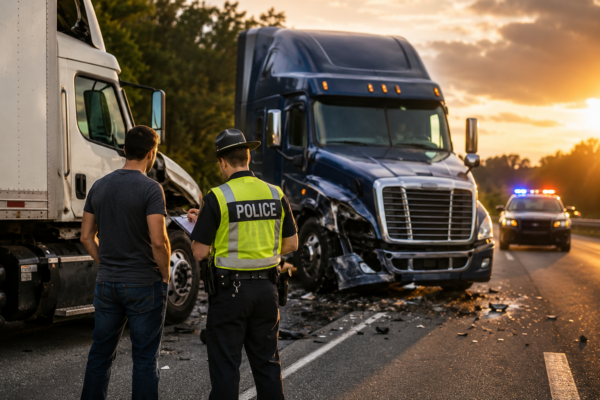
Truck accidents rarely happen in a vacuum. A crash on I-285, I-75, I-85, GA-400, or a busy Atlanta surface road may involve several vehicles making split-second decisions around a large commercial truck. One driver may have changed lanes without enough space. Another may have been speeding. A truck driver may have followed too closely, failed to check blind spots, or reacted too late.

2025 Atlanta's Best - Defense Law Firm
BadAss Attorney

Best Lawyers In America
10 Consecutive Years Selected to Super Lawyers

AVVO Client's Choice

Best Lawyers Best Law Firms
Georgia law allows fault to be divided when multiple people or entities contributed to an injury. Under Georgia’s apportionment statute, a factfinder may assign percentages of fault to responsible parties, and a plaintiff’s damages may be reduced by the plaintiff’s own percentage of fault. A plaintiff generally cannot recover damages if found 50 percent or more responsible for the claimed injury or damages.
That rule matters because trucking cases often involve more than one insurance company. Each insurer may try to shift blame to someone else. The trucking company may blame a nearby car. Another driver may blame the truck. An insurer may argue the injured person braked suddenly, changed lanes, or did not avoid the collision.
Shared fault does not mean your claim has no value. It means the evidence must be developed carefully.
Common Ways Multiple Drivers May Share Fault
A Georgia truck accident may involve shared responsibility when several decisions combined to cause the crash. Examples may include:
- A truck driver follows too closely while a passenger vehicle cuts into the lane.
- A speeding driver forces traffic to brake, and the truck driver fails to maintain a safe stopping distance.
- A distracted driver drifts into a truck’s blind spot while the truck driver changes lanes without checking mirrors.
- A rideshare driver stops suddenly in a travel lane while a commercial driver is driving too fast for conditions.
- A truck driver is fatigued, while another motorist makes an unsafe merge.
- A vehicle breaks down without proper hazard signals, while the truck driver fails to slow in time.
In these cases, the core question is not simply, “Who hit whom?” The stronger question is, “Whose choices helped cause the crash, and by how much?”
A police report may help, but it is not always the final word. Truck accident liability may require dash camera footage, electronic logging records, black box data, witness statements, vehicle inspections, cell phone records, road evidence, and expert analysis.
He's the only lawyer in the State of Georgia to ever be recognized for all three of these accomplishments. Received the Samurai Lawyer Award for having gone to jail for a total of 4 days in order to save his own client Received the BadAss Lawyer Award for the biggest impact of all DUI lawyers in DUI defense in the country Received the vote of Georgia Lawyers as a Superlawyer in DUI Law for 10 straight consecutive yearsGreg Willis has been successful at defending DUI cases (over 93.1% without a conviction)
How Shared Fault Affects Compensation
When fault is divided, compensation may be reduced by the injured person’s share of responsibility. For example, say an injured driver has $200,000 in proven damages after a truck crash. If that driver is found 20 percent at fault, the recovery may be reduced by 20 percent. If the injured driver is found 50 percent or more at fault, Georgia law may bar recovery.
The math can become more layered when several defendants are involved. A jury may assign percentages to the truck driver, trucking company, another motorist, and the injured person. Each named defendant may be responsible only for the portion assigned to that defendant.
This is why early case investigation matters. A small shift in fault percentages can affect the value of a claim. It can also affect which insurance policies are available and how settlement talks proceed.
Who Else May Be Liable Besides the Drivers?
Although the title of this article focuses on multiple drivers, Georgia truck accident cases can involve non-driver fault as well. A commercial truck crash may include claims against:
- A trucking company that hired an unsafe driver
- A company that failed to train or supervise a driver
- A maintenance provider that missed brake, tire, or steering problems
- A cargo loading company that overloaded or improperly secured freight
- A vehicle parts manufacturer if a defective component contributed
- A government entity or contractor if road design or work zone hazards played a role
Fault can also involve nonparties in some situations. Georgia’s apportionment law allows the trier of fact to consider the fault of people or entities that contributed to the alleged injury or damages, even if they were not named as parties, subject to procedural rules.
That makes identification important. If the wrong parties are left out, insurance companies may use that gap to dispute responsibility. If all responsible parties are identified early, the injured person may have a clearer path toward proving what happened.
Greg has truly mastered his craft. His preparation is second to none and his confidence helps reduce the nervousness and anxiety his clients face. He is a real life version of Harvey Specter and I highly recommend him.” - Travis Greg and his team are absolutely incredible. Greg explained everything to me in detail, as this is the first ever time I have been arrested. Regular updates throughout the process which allowed me to get on with everyday life. 200% I would recommend Greg and his team to anyone with a DUI case." - James Hellens Mr Willis is the best in the business. He knows the law inside and out. I was in a serious jam and Greg got my dui reduced to a reckless driving. This man will fight for you every step of the way." - Anonymous
Why Truck Accidents Are Different From Ordinary Car Crashes
A commercial truck is larger, heavier, and harder to stop than a passenger vehicle. Truck crashes often cause severe injuries because of the force involved. They also tend to create more complex evidence issues.
A truck accident investigation may examine:
- Driver logs and hours of service issues
- Delivery schedules and pressure to meet deadlines
- Maintenance history
- Brake and tire condition
- Truck weight and cargo securement
- Dash camera or onboard video
- Event data recorder information
- Driver qualification files
- Prior safety violations
- Dispatch communications
If alcohol or drug impairment is suspected after a crash, the case may overlap with criminal law, license consequences, CDL issues, or hit-and-run concerns. For background on commercial driving consequences, readers may find the firm’s discussion of https://www.willislawga.com/2024/08/06/understanding-commercial-drivers-licenses-cdl-and-suspensions/ useful. If the crash involved suspected impaired driving, this overview of https://www.willislawga.com/2024/06/18/understanding-georgia-cdl-dui-laws-essential-regulations-every-driver-should-know/ may also provide helpful context.
What Evidence Helps Prove Shared Fault?
Evidence should answer three questions: what happened, who contributed, and how each action affected the crash.
Useful evidence may include:
- Photos and videos of the scene
- Skid marks, debris location, and vehicle resting positions
- Traffic camera or business surveillance footage
- Truck dash camera footage
- Police body camera footage
- 911 recordings
- Medical records
- Witness names and statements
- Vehicle damage patterns
- Electronic logging device data
- Cell phone records when distraction is suspected
- Repair and maintenance records
- Inspection reports
- Weather and road condition evidence, when relevant
In Atlanta, Georgia, traffic congestion can make witness evidence especially valuable. A crash near a highway interchange, construction zone, or crowded exit ramp may unfold in front of many drivers. Those witnesses may leave before police finish the report. If possible, names, numbers, photos, and videos should be preserved quickly.
Related Videos
Choosing a Georgia DUI Attorney
Defenses and Strategies to Defend a DUI Charge
What Insurance Companies Often Do in Shared Fault Cases
Shared fault gives insurers room to argue. One insurance company may accept only a small percentage of responsibility. Another may deny fault entirely. A truck insurer may argue the injured driver caused the crash. A passenger vehicle insurer may claim the truck driver had the final chance to avoid impact.
Common insurance arguments include:
- The injured person was speeding.
- The injured person made an unsafe lane change.
- Another driver caused the chain reaction.
- The truck driver had no time to stop.
- The crash was unavoidable.
- The injuries were not caused by the crash.
- The damages are lower than claimed.
These arguments are not always supported by evidence. They should be tested against the full record, not accepted at face value.
When a Truck Accident Also Involves Hit-and-Run Issues
Some multi-vehicle truck crashes involve a driver who leaves the scene. A hit-and-run can make shared fault harder to sort through because one part of the story may be missing.
For example, a vehicle may cut off a tractor-trailer and then leave before police arrive. The truck driver may swerve, causing a crash with another car. The injured person may know only that the truck hit them, while the truck driver blames an unknown vehicle.
That type of case may require footage from nearby businesses, traffic cameras, dash cameras, and witnesses. The firm has related information on https://www.willislawga.com/2024/07/17/understanding-comparative-negligence-in-georgia-hit-and-run-cases/ and https://www.willislawga.com/2024/02/13/legal-consequences-penalties-for-hit-run-offenses-in-atlanta-ga/.
What To Do After a Georgia Truck Accident With Multiple Drivers
After a serious truck crash, your health comes first. Call 911, get medical care, and follow medical advice. Some injuries are not obvious at the scene, especially when adrenaline is high.
When it is safe, consider these steps:
- Take photos of all vehicles, license plates, road signs, debris, and visible injuries.
- Get names and contact information for witnesses.
- Avoid arguing about fault at the scene.
- Do not guess about speed, distance, or responsibility.
- Report pain and symptoms accurately to medical providers.
- Keep discharge papers, bills, prescriptions, and follow-up instructions.
- Avoid posting about the crash on social media.
- Speak with an attorney before giving recorded statements to insurers.
If a DUI, CDL, or license issue is connected to the crash, the firm’s Atlanta-focused DUI resources may help explain related procedures. You can review https://www.willislawga.com/dui-attorneys-in-fulton-county-georgia/ for local defense context.
How an Attorney Can Help With Shared Fault
A truck accident involving multiple drivers can become confusing quickly. An attorney can help identify responsible parties, preserve evidence, analyze insurance coverage, respond to comparative fault arguments, and work with experts when needed.
A lawyer may also help prevent one insurer from controlling the story before all evidence is gathered. That matters because the first version of events is not always the correct version.
Willis Law Firm helps people in Atlanta, Georgia understand the legal issues that can follow serious traffic incidents, including DUI, CDL, hit-and-run, and related driver responsibility concerns. If your situation involves a crash, suspected impairment, or a commercial driver issue, a consultation can help you understand your next steps and avoid mistakes that may affect your rights.
This article is for informational purposes only and is not legal advice. Consult an attorney about your specific situation.