
A Georgia DUI does not automatically end your hunting privileges or firearm rights. Under Georgia DUI law, a first or second DUI conviction is a misdemeanor, a third conviction is a high and aggravated misdemeanor, and a fourth or subsequent qualifying conviction within the statutory ten-year period is a felony. That felony classification can change the firearm analysis because Georgia law generally prohibits a person convicted of a felony from receiving, possessing, or transporting a firearm.
Your hunting license and your legal ability to possess a firearm are separate questions. You should review the exact DUI charge, prior convictions, bond conditions, probation terms, any protective or court orders, and any separate drug or weapons issues before you hunt or handle a firearm.
A valid hunting license does not override a firearm prohibition. Before you hunt, confirm both your hunting privileges and your legal ability to possess the equipment you plan to use.

2025 Atlanta's Best - Defense Law Firm

BadAss Attorney

Best Lawyers In America

10 Consecutive Years Selected to Super Lawyers

AVVO Client's Choice

Best Lawyers Best Law Firms
Does a Misdemeanor DUI Automatically End Your Firearm Rights? 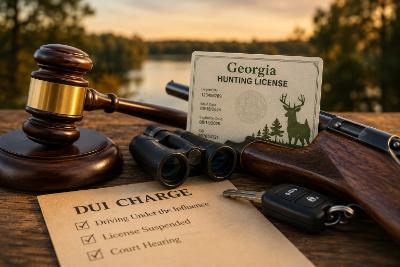
A standard Georgia misdemeanor DUI usually does not, by itself, create the same firearm prohibition that follows a felony conviction.
O.C.G.A. § 40-6-391 classifies a first or second DUI conviction as a misdemeanor and a third conviction as a high and aggravated misdemeanor. A fourth or subsequent qualifying DUI conviction within ten years is a felony under the statute’s counting rules.
Federal law also distinguishes many misdemeanors from crimes that trigger the federal felon-in-possession prohibition. Under 18 U.S.C. § 921(a)(20), a state misdemeanor punishable by two years or less is excluded from the federal definition of a crime punishable by imprisonment for a term exceeding one year. Georgia misdemeanor DUI sentences under O.C.G.A. § 40-6-391 do not exceed 12 months. For that reason, an ordinary misdemeanor DUI does not usually trigger 18 U.S.C. § 922(g)(1) by itself.
For more information about Georgia DUI penalties, visit:
https://www.willislawga.com/dui-penalties-in-georgia/
Is a DUI Arrest Different From a DUI Conviction?
Yes. A DUI arrest is not a conviction, and an arrest for a standard misdemeanor DUI does not automatically make you a prohibited firearm possessor.
You still need to review every court order connected with the case. If your bond order, probation order, protective order, or another court directive restricts firearms or weapons, you need to follow that restriction while it remains in effect.
A felony case can also create issues before conviction. Georgia’s weapons carry license statute lists pending felony proceedings as a disqualifying condition for a weapons carry license. Federal law separately restricts receiving a firearm or ammunition that has moved in interstate or foreign commerce while you are under indictment for a crime punishable by imprisonment for more than one year.
The exact status of the case matters. A misdemeanor arrest, a felony accusation, a felony indictment, a conviction, and a court-imposed weapons restriction can produce different results.
He's the only lawyer in the State of Georgia to ever be recognized for all three of these accomplishments. Received the Samurai Lawyer Award for having gone to jail for a total of 4 days in order to save his own client Received the BadAss Lawyer Award for the biggest impact of all DUI lawyers in DUI defense in the country Received the vote of Georgia Lawyers as a Superlawyer in DUI Law for 10 straight consecutive yearsGreg Willis has been successful at defending DUI cases (over 93.1% without a conviction)
When Can a Georgia DUI Become a Felony?
Under O.C.G.A. § 40-6-391, a fourth or subsequent qualifying DUI conviction within the statutory ten-year period is a felony. The statute provides for a sentence of one to five years for that fourth or subsequent DUI, subject to the sentencing provisions in the law.
A felony DUI changes the firearm analysis. O.C.G.A. § 16-11-131 generally prohibits a person convicted of a felony from receiving, possessing, or transporting a firearm. The statute defines a firearm broadly enough to include handguns, rifles, shotguns, and other weapons that expel a projectile by an explosive or electrical charge.
If you have a felony DUI conviction, do not assume that hunting season, private property, family ownership of the gun, or possession of a hunting license creates an exception. The central question is whether you may lawfully receive, possess, or transport the firearm.
For information about felony DUI defense in Atlanta, Georgia, visit:
https://www.willislawga.com/atlanta-felony-dui-attorneys/
Does a DUI Cancel a Georgia Hunting License?
A Georgia hunting license and your legal right to possess a firearm are separate.
Georgia Department of Natural Resources licensing guidance bases hunting-license requirements on factors such as residency, age, license duration, hunting activity, location, and the species or privilege involved. The public licensing guidance does not list an ordinary misdemeanor DUI conviction as an automatic hunting-license disqualifier.
That does not mean every hunter with a DUI has the same answer. Separate wildlife violations, court orders, probation terms, or firearm restrictions can affect what you may lawfully do in the field.
Before you hunt, ask both of these questions:
- Is your hunting license, harvest record, permit, or other required hunting privilege valid for the species, season, and location?
- Are you legally allowed to possess or use the firearm, muzzleloader, bow, crossbow, or other equipment you plan to take?
If you are uncertain about firearm eligibility, obtain legal advice before you buy, borrow, transport, carry, or handle a firearm.
Greg has truly mastered his craft. His preparation is second to none and his confidence helps reduce the nervousness and anxiety his clients face. He is a real life version of Harvey Specter and I highly recommend him.” - Travis Greg and his team are absolutely incredible. Greg explained everything to me in detail, as this is the first ever time I have been arrested. Regular updates throughout the process which allowed me to get on with everyday life. 200% I would recommend Greg and his team to anyone with a DUI case." - James Hellens Mr Willis is the best in the business. He knows the law inside and out. I was in a serious jam and Greg got my dui reduced to a reckless driving. This man will fight for you every step of the way." - Anonymous
Can a Felony DUI Affect Hunting Even If Your License Is Valid?
Yes. A felony DUI can prevent you from lawfully hunting with a firearm even when your hunting license remains valid.
Georgia DNR enforcement reports include cases in which convicted felons were charged with firearm possession while hunting. Georgia DNR also directs hunters to the State Board of Pardons and Paroles for information about restoration of firearm rights.
Hunters should pay close attention to muzzleloaders. The Georgia State Board of Pardons and Paroles states that a muzzleloader is considered a firearm for restoration-of-rights purposes.
Bow hunting can be different. The State Board of Pardons and Paroles states that a person may bow hunt without receiving a pardon or restoration of civil and political rights and advises contacting a game warden about applicable hunting laws and stipulations. A separate bond condition, probation condition, or court order that restricts “weapons” may still affect your situation.
Related Videos
Choosing a Georgia DUI Attorney
Defenses and Strategies to Defend a DUI Charge
What About a Georgia Weapons Carry License After a DUI?
A Georgia weapons carry license is a separate legal issue from a hunting license and from basic firearm possession.
O.C.G.A. § 16-11-129 lists several conditions that can prevent issuance of a weapons carry license. These include a felony conviction that has not been pardoned, pending felony proceedings, certain controlled-substance convictions, and other listed disqualifiers.
An ordinary misdemeanor DUI is not listed as an automatic weapons carry license disqualifier standing alone. The statute does allow revocation after notice and a hearing based on specified grounds that include chronic alcohol or narcotic usage. Recent inpatient treatment at an alcohol or drug treatment center can also affect eligibility under the statute.
Your DUI case may affect a weapons carry license differently when the case involves a felony charge, a separate drug offense, a federal firearm prohibition, or another court restriction.
Could a Drug DUI Create Different Firearm Concerns?
Yes. A DUI involving drugs can raise firearm issues that may not be present in an alcohol-only DUI.
A drug DUI does not automatically mean that you committed a separate controlled-substance possession offense. Your actual charges, the substance involved, your legal authority to possess or use that substance, and the evidence all matter.
If your case also includes unlawful possession, manufacture, or distribution of a controlled substance, a separate drug conviction may affect weapons carry license eligibility or firearm possession. Federal law also prohibits firearm possession by a person who is an unlawful user of or addicted to a controlled substance. Whether that federal restriction applies depends on the facts.
Do not assume that the label “drug DUI” answers the firearm question. Review the full charging documents and any related drug allegations.
What Should You Do After a Georgia DUI Arrest If You Hunt or Own Firearms?
If hunting, sport shooting, firearm ownership, or a weapons carry license matters to you, tell your DUI attorney early. You should understand the collateral effects of a proposed plea, conviction, bond condition, or probation term before the case is resolved.
Useful steps include:
- Keep copies of your citation, bond order, charging documents, probation paperwork, and final disposition.
- Confirm whether the DUI is being treated as a misdemeanor, high and aggravated misdemeanor, or felony.
- Ask whether any felony proceedings or indictment affect your ability to receive a firearm or your weapons carry license.
- Read every bond, probation, protective, and court order for firearm or weapons restrictions.
- Do not buy, borrow, transport, carry, or handle a firearm when your eligibility is uncertain.
- Check your hunting-license, harvest-record, permit, and season requirements separately from firearm eligibility.
- Ask how a proposed plea or sentence could affect firearm possession before you enter the plea.
- If you plan to bow hunt while firearm rights are restricted, confirm the current hunting rules and check for any court order that uses the broader term “weapons.”
Learn more about attorney Greg Willis:
https://www.willislawga.com/georgia-attorney-greg-willis/
Can Firearm Rights Be Restored After a Felony DUI?
Georgia provides a process for firearm-rights restoration in some cases, but restoration is not automatic.
O.C.G.A. § 16-11-131 recognizes an exception when a person has been pardoned for the felony and the terms of the pardon expressly authorize the person to receive, possess, or transport a firearm. The Georgia State Board of Pardons and Paroles separately explains that a restoration of civil and political rights does not automatically restore firearm rights. Firearm rights must be specifically granted.
Completing probation or finishing a sentence does not, by itself, mean that you may possess a firearm again. Federal law may also affect the analysis. Before possessing a firearm after a felony conviction, have the exact conviction and any pardon, discharge, restoration order, or other post-conviction relief reviewed.
Speak With an Atlanta DUI Attorney About Hunting and Firearm Concerns
A Georgia DUI case can affect more than your driving privileges. If hunting, firearm possession, a weapons carry license, or an upcoming hunting season matters to you, address those concerns before you enter a plea or make decisions about firearms.
Willis Law Firm represents people facing DUI charges in Atlanta, Georgia, and nearby areas. Greg Willis and the firm’s DUI defense team can review the level of the DUI charge, prior history, court conditions, proposed case outcomes, and related firearm concerns so you can understand which rules may apply to your situation.
Call 404-800-0025 for a free consultation.
Contact Willis Law Firm:
https://www.willislawga.com/contact-us/
This article is for general informational purposes only and is not legal advice. Reading this article does not create an attorney-client relationship. Consult an attorney about your specific situation. This website constitutes attorney advertising.